
What Is Wudu? A Step-by-Step Guide to Wudu and Ghusl
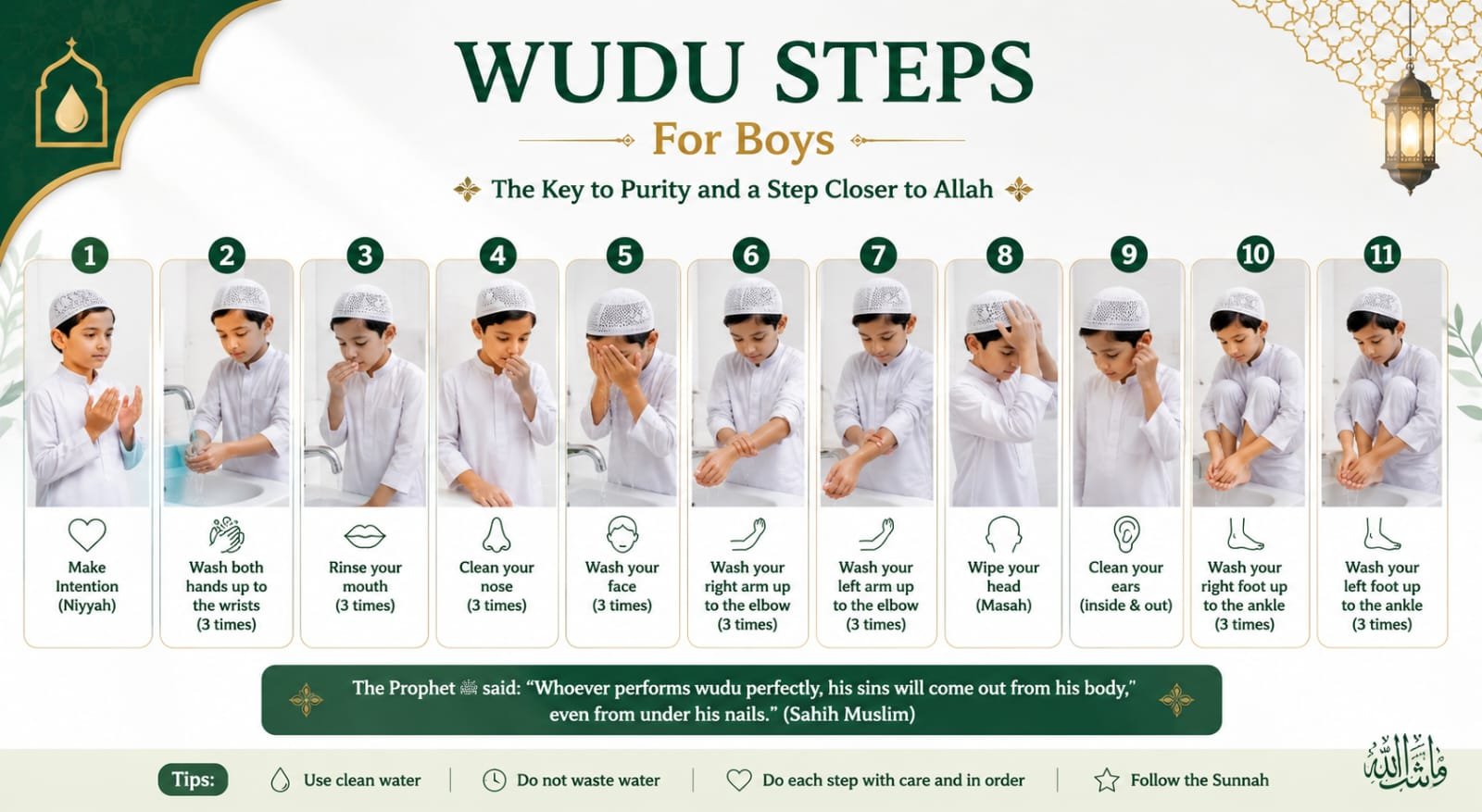
Quick answer: Wudu is the minor ritual purification a Muslim performs before Salah — washing the hands, mouth, nose, face and arms, wiping the head and ears, and washing the feet, all with the intention of purity. Ghusl is the full ritual bath required after major ritual impurity. Both are acts of worship, not merely hygiene.
Purification in Islam
Islam places purification at the very doorstep of worship. A Muslim is taught to keep the body, clothing, prayer space and heart clean, and no prayer is entered carelessly. That is why Taharah (purity) is treated as a condition of Salah rather than an optional extra.
Washing the limbs is also a reminder to wash the heart — from sin, arrogance, laziness and heedlessness. Allah says:
"Indeed, Allah loves those who are constantly repentant and loves those who purify themselves."
What Is Wudu?
Wudu, often translated as ablution, is the minor ritual washing performed with clean water and a sincere intention to be pure for worship. It is obligatory before Salah, and it is recommended in many other situations because it keeps a Muslim in a constant state of readiness for worship. Its foundation is stated directly in the Quran:
"O you who have believed, when you rise to prayer, wash your faces and your forearms to the elbows and wipe over your heads and wash your feet to the ankles."
The verse names the four obligatory acts of Wudu: washing the face, washing the arms to the elbows, wiping the head, and washing the feet to the ankles. The remaining steps below are Sunnah practices that complete and perfect the Wudu.
How to Perform Wudu: 11 Steps in Order
The following order follows the infographic above. Minor details differ slightly between the schools of Islamic law, so a new Muslim should learn from a reliable teacher rather than feel overwhelmed by differences.
- Make the intention (Niyyah). Intend in your heart that this washing is for purification and worship. The intention is not spoken aloud as a formula; it is the resolve of the heart.
- Say Bismillah and wash both hands. Wash the hands up to the wrists three times, passing water between the fingers.
- Rinse the mouth. Take water into the mouth, swill it around and expel it — three times.
- Clean the nose. Gently sniff water into the nostrils and blow it out, three times. While fasting, do this lightly so no water is swallowed.
- Wash the face. Wash from the hairline to the chin and from ear to ear, three times, making sure no part is left dry.
- Wash the right arm. Wash from the fingertips up to and including the elbow, three times.
- Wash the left arm. Repeat the same on the left arm, three times.
- Wipe the head (Masah). With wet hands, wipe over the head once, moving from the front to the back.
- Clean the ears. With the same wetness, wipe the inside of the ears with the index fingers and the back of the ears with the thumbs.
- Wash the right foot. Wash up to and including the ankle three times, passing a finger between the toes.
- Wash the left foot. Do the same on the left foot, three times.
The reward for doing this carefully is immense. The Prophet ﷺ said: "Whoever performs Wudu perfectly, his sins will come out from his body, even from under his nails." (Sahih Muslim)
Do not waste water. The Sunnah is a complete Wudu with a small amount of water. Islam teaches thorough cleanliness without extravagance, even when standing beside a flowing river.
What Breaks Wudu?
Once Wudu is broken, it must be renewed before praying. Beginners should focus on the main, agreed-upon cases:
| What breaks Wudu | Meaning |
|---|---|
| Using the toilet | Urination or defecation breaks Wudu. |
| Passing wind | Passing gas breaks Wudu. |
| Deep sleep | Sleep in which a person loses awareness of their surroundings breaks Wudu. |
| Loss of consciousness | Fainting, intoxication or anything that removes awareness breaks Wudu. |
| Other detailed matters | Some cases differ between the schools of Islamic law and should be learned from a reliable scholar. |
If you are ever unsure about a particular situation, ask a knowledgeable person instead of guessing repeatedly — constant doubt is itself a burden that Islam does not place on the believer.
What Is Ghusl?
Ghusl is the full ritual bath. It is required after major ritual impurity and must be completed before returning to acts of worship that require full purification, such as Salah.
Ghusl is not simply an ordinary shower: the intention and the required washing are what make it valid. That said, a normal shower does count as Ghusl when a person makes the proper intention and washes the entire body correctly.
In simple words: Wudu washes specific parts of the body. Ghusl washes the entire body with the intention of removing major ritual impurity.
When Is Ghusl Required?
This is a sensitive subject, but it is essential knowledge for every Muslim. Islam teaches purification clearly and respectfully.
| When Ghusl is required | Basic explanation |
|---|---|
| After marital relations | Ghusl is required after sexual intercourse. |
| After ejaculation | Required whether it occurs while awake or through a wet dream. |
| After menstruation ends | A woman performs Ghusl once her period has ended, before resuming prayer. |
| After postnatal bleeding ends | A woman performs Ghusl after post-childbirth bleeding has stopped. |
| Entering Islam | Many scholars recommend or require Ghusl for a new Muslim; new Muslims should follow reliable guidance. |
Rulings connected to menstruation, postnatal bleeding, discharge and wet dreams carry further detail. For a specific personal case, ask a trustworthy scholar or teacher.
How to Perform Ghusl
There is a detailed Sunnah method for Ghusl, and it is worth learning properly. At its simplest, Ghusl requires the intention of purification and washing the whole body so that water reaches the skin and the roots of the hair.
- Make the intention. Intend in the heart to perform Ghusl for purification.
- Say Bismillah. Begin in the name of Allah.
- Remove any impurity. Wash away any visible impurity from the body first.
- Perform Wudu. Most descriptions of Ghusl include performing a complete Wudu as part of the process.
- Wash the entire body. Pour water over the head and then the whole body, making sure it reaches the hair roots, underarms, navel, and between the fingers and toes.
- Stay moderate with water. Ghusl should be complete but never wasteful.
After a valid Ghusl a person is purified from major ritual impurity. According to many scholars a complete Ghusl also covers Wudu, though the details depend on how it was performed and whether anything broke the Wudu afterwards.
What if Water Is Unavailable? Tayammum
Salah still cannot be prayed without purification — but Islam is never a religion of hardship. When water is genuinely unavailable, or when using it would harm a person because of illness or injury, Tayammum (dry purification with clean earth) is permitted in place of Wudu or Ghusl. Learn its correct method from a qualified teacher so that you are prepared before you ever need it.
Teaching Wudu to Children
Children learn purification best by watching and repeating, not by memorising rules. Use the infographic above as a bathroom wall chart, perform Wudu beside your child while naming each step aloud, and praise the effort rather than correcting every detail at once. Once the order becomes natural, connect it to prayer so the child sees Wudu as the beginning of standing before Allah.
At Al-Tarteel, purification, prayer and etiquette are taught alongside recitation in our Noorani Qaida course, so young students build worship habits from the very first lesson.
Frequently Asked Questions
What is Wudu in Islam?
Wudu is the minor ritual purification performed before Salah and certain acts of worship. It involves washing specific parts of the body with clean water and the intention of purification.
How many steps are there in Wudu?
The Quran names four obligatory acts: washing the face, washing the arms to the elbows, wiping the head, and washing the feet to the ankles. The complete Sunnah method, shown in the infographic above, is commonly taught as eleven steps in order.
What breaks Wudu?
Using the toilet, passing wind, deep sleep in which awareness is lost, and loss of consciousness. Some finer cases differ between the schools of Islamic law.
When is Ghusl required?
After marital relations, after ejaculation (awake or through a wet dream), after menstruation ends, and after postnatal bleeding ends. Many scholars also recommend it for someone entering Islam.
Can a Muslim pray without Wudu?
No — purification is a condition for Salah. If water is unavailable or cannot be used, Tayammum is permitted in specific circumstances.
Do you need Wudu to read the Quran?
Most scholars hold that Wudu is required to touch the physical Mushaf. Reciting from memory or reading from a screen is permitted without Wudu according to most scholars, though being in a state of Wudu is always better.
Learn Purification, Prayer and Quran the Right Way
Our certified tutors teach Wudu, Salah and Quran recitation in live 1-on-1 online classes for children and adults — at your own pace, from home.
Book A Free Trial ClassContinue Reading
- The Art of Tajweed: Perfecting Your Quranic Pronunciation
- 5 Effective Quran Memorization Techniques for Busy People
- Studying Tafseer: Deepening Your Connection to the Holy Quran
Reference: Adapted with additional guidance from "What Is Wudu? A Beginner's Guide to Wudu and Ghusl" (Allah's Word). For rulings on personal situations, always consult a qualified scholar.